Probing Dark Matter-Baryon Interactions using JWST Observations of Early Galaxies
Pretext
Dark matter is a hypothesized form of matter that is essential to our understanding of the Universe. Rotation velocities of stars in galaxies, motion of gas in galaxy clusters, and the existence of structures as we see on large scales, all require the existence of some form of matter beyond what we can ‘see’. This form of matter, called ‘dark matter’, has no conclusive evidence yet. However, numerous experiments all across the globe are working to probe the properties of dark matter through astrophysical observations (also called indirect detection experiments), direct detection experiments involving dark matter potentially scattering with a solid material, or in the form unaccounted energy losses in particle colliders.
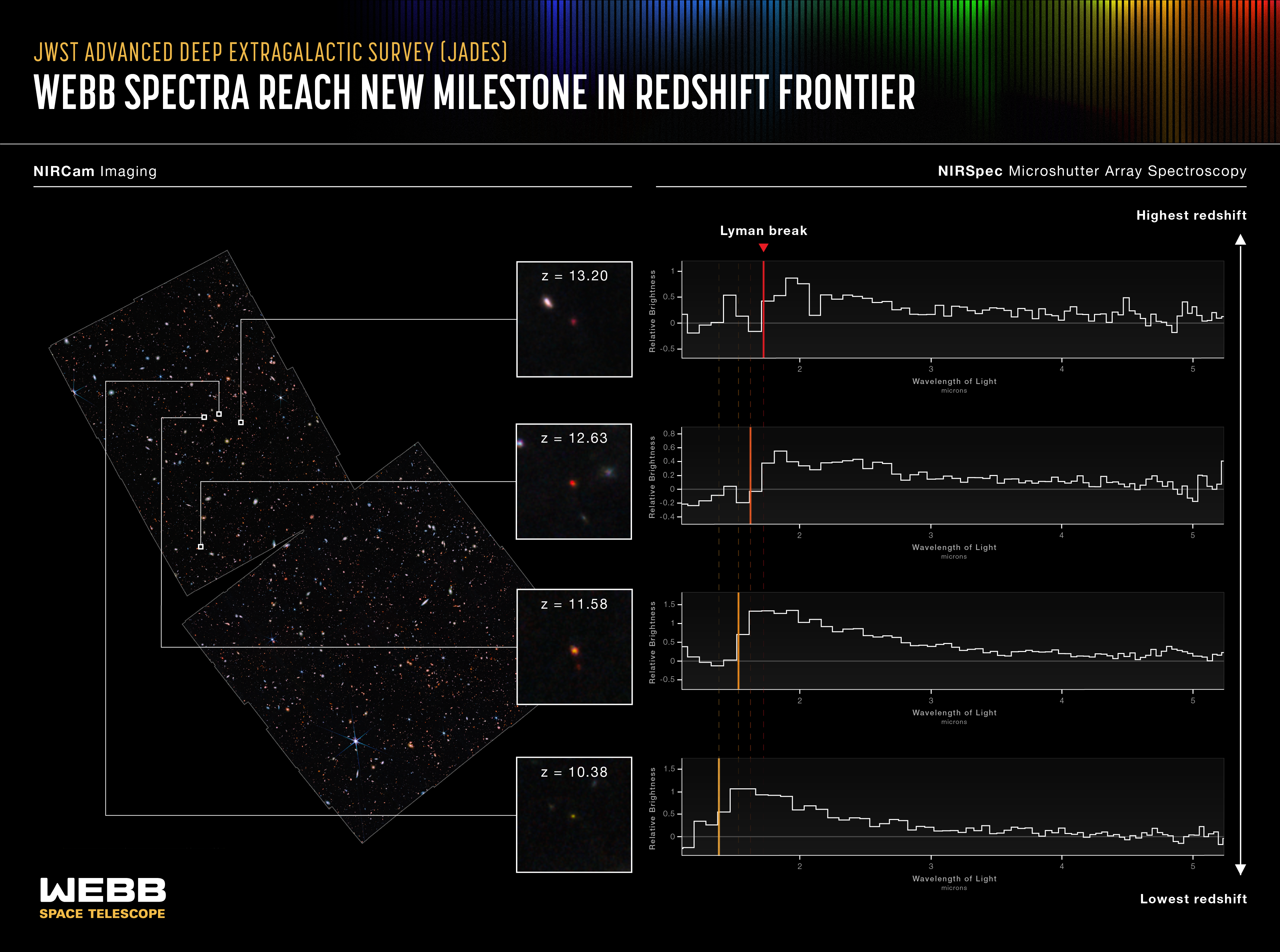
While none of these experiments have revealed a solid evidence for dark matter, we know how crucial dark matter is to our own existence. In fact, galaxies such as our Milky Way would not have formed in the first place if dark matter was not there to hold the matter together. Similarly, recent observations using some of the most powerful telescopes, for example the James Webb Space Telescope (JWST) that was launched back in 2021, have found numerous galaxies in the very, very distant Universe. These galaxies are so far away from us that the light from them takes billions of years to reach our telescopes. This means that many of these galaxies were formed when the Universe was a few hundred million years old, which is just 2% of its current age, 14 billion years. The existence and characterization of these galaxies is a great test of dark matter properties. This is the general principle that forms the backbone of this project.
Cosmology
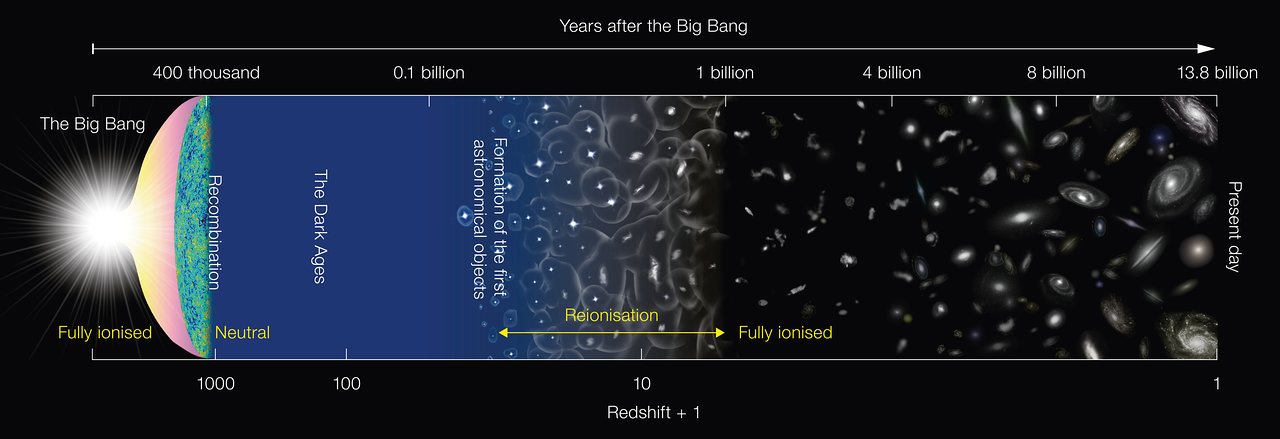
Why is dark matter crucial to the existence of galaxies? First of all, recall what galaxies essentially are. They are regions of space where matter is denser as compared to the background Universe. For comparison, the density of ordinary matter in the plane of our Galaxy is nearly 1 proton per cubic centimeter, while that in the background Universe is roughly 1 per every cubic meter. A difference of 6 orders of magnitude! On the other hand, we have an idea of how large these difference was in the early Universe - from the Cosmic Microwave Background (CMB) radiation. The tiny fluctuations that we see in this radiation field, produced when the Universe was just a few hundred thousand years old, are incredibly small - 1 part in \(10^5\). Going from these almost inconceivable fluctuations to the variety of dense structures like galaxies is what has motivated cosmologists to come up with a theory of structure formation. In this theory, these tiny over-densities produced in the early Universe undergo a process of ‘gravitational collapse’ - they crumble under their own gravity to form what we call galaxies.
Where does dark matter come into all of this? As it turns out, ordinary matter interacts with radiation (such as electromagnetic radiation of different frequencies) and faces a radiation pressure. This pressure tends to prevent collapse into denser structures. On the other hand, if we include in our theory of structure formation a form of matter devoid of pressure, we increase the strength of gravity without adding extra pressure. Then we can proceed happily with collapsing these minute overdensities into something cosmologists call ‘halos’ of matter. The visible part of our Milky Way Galaxy (and other galaxies we have seen) sits near the center of a larger halo of dark matter. This theory of gravitational collapse and growth of structures is highly successful in reproducing observations of the Universe at the largest length scales. Since dark matter in this theory does not have a significant pressure, it is termed ‘Cold Dark Matter’ (CDM).
Now, before we move to the next point, please note that the above discussion is highly oversimplified. In reality, the entire theory of cosmological structure formation stands on the shoulders of Einstein’s theory of General Relativity which, among its weird predictions, also projected that the Universe is expanding. When Einstein first noticed this, it was still believed that the Universe is static. This convinced him to consider adding a ‘Cosmological Constant’ to his equations of General Relativity in order to keep the Universe stationary. Now, even though the Universe is actually expanding, we still do need a cosmological constant (debatable!) or something of the sort. This is because the Universe is not just expanding, but its rate of expansion is increasing with time. The phenomenon responsible behind this acceleration is called ‘Dark Energy’, and as it turns out, the cosmological constant is just one of the candidates for dark energy. Well, in fact, recent observations from DESI hint that dark energy does not come from cosmological constant.
Dark Matter - Baryon Interactions
Now that we have a cosmological model with Cold Dark Matter (CDM), we can ask the question: Does dark matter interact with ordinary matter? The simple answer is, it does. Dark matter, like any form of matter or energy, interacts via gravity. However, gravity is the weakest of the four fundamental forces, tens of orders of magnitude weaker than the others.
A more apt question to ask would be: does dark matter interact with ordinary matter via something other than gravity? This is a more difficult question to answer. First of all, ordinary matter belongs to the Standard Model of particle physics, which accurately dictates which kind of matter will interact via which force. This model was created only after the existence of the various kinds of particles and their interactive properties were studied. On the other hand, no conclusive evidence for the existence or interactions of dark matter have been found. Does this mean that dark matter does not interact via anything other than gravity? No. If we had the privilege of performing infinitely sensitive measurements our answer could have been a yes. However, any measurement has a finite sensitivity, and hence can only put upper limits on the interaction strength between dark matter and ordinary matter. A feather placed on a weighing scale would show zero weight, but that does not mean the feather has exactly zero weight. The better the sensitivity of the experiment, the stronger upper limits one gets, with a hope for detection at some point.
All we know about dark matter interactions with ordinary matter is that there are upper limits on the interaction strength. This strength is parametrized using the interaction ‘cross-section’. Models of dark matter that predict a cross-section higher than the upper limits inferred from experiments are then said to be ‘ruled out’. Then one can develop more sensitive tests that can potentially ‘discover’ or ‘rule out’ the models that remain. As a rule of thumb, ruling out a model requires that one of the predictions is false. A discovery would require that all of the predictions of this model are correct.
We would like to go with the easy method - perform an experiment, put upper limits on the cross-section, and rule out part of the remaining parameter space. Here we are concerned about constraining the interaction cross-section between dark matter and particles in the Standard Model, such as photons, neutrinos, protons, and electrons. When dark matter interacts with one of these particle species in the early Universe, it greatly affects the potential of dark matter to collapse and form structures. The mechanism for this involves two processes- First, recall that we need cold dark matter in order to form these structures. Now, Standard Model particles in the early Universe are generically less ‘cold’ as compared to dark matter, because they have sufficiently large interaction strengths. Now, if dark matter had a comparably large interaction strength, it would also obtain heat energy from Standard Model particles, and become more ‘warm’. Dark matter would no longer remain pressureless, and gravitational collapse would partially cease. To understand the second mechanism, imagine a dark matter particle moving through a sea of ordinary particles. The interaction we just introduced would apply a drag force on the dark matter particle, slowing it down. Conversely, a moving sea of Standard Model particles would rinse dark matter particles out of collapsing halos, thus preventing a collapse.
Both of these effects reduce the possibility of forming dark matter halos in the early Universe. It turns out that the effect is more pronounced for dark matter halos with small masses, because their gravitational potential wells are ‘too shallow’ to hold enough interacting dark matter. On the other hand, larger halos are not affected too much by dark matter interactions. This immediately affects the number of small-mass (and hence, fainter) galaxies formed at a given point of time in the cosmological evolution. Observing the number density of galaxies at early times, such as those by the JWST, can tell us whether this ‘suppression’ of fainter galaxies is actually real. The observation of this suppression in faint galaxies would provide evidence for the existence of dark matter - Standard Model interactions. On the other hand, its non-observation would rule out the models where the interaction is sufficiently strong to cause an observable suppression, and hence put an upper bound on the interaction strength.
This is what we seek to explore in this project, where we use data for distant galaxies observed by the JWST to put constraints on the interaction of dark matter with ordinary matter.
Details of the work
Coming soon…
Guide to learn this work
Coming soon…